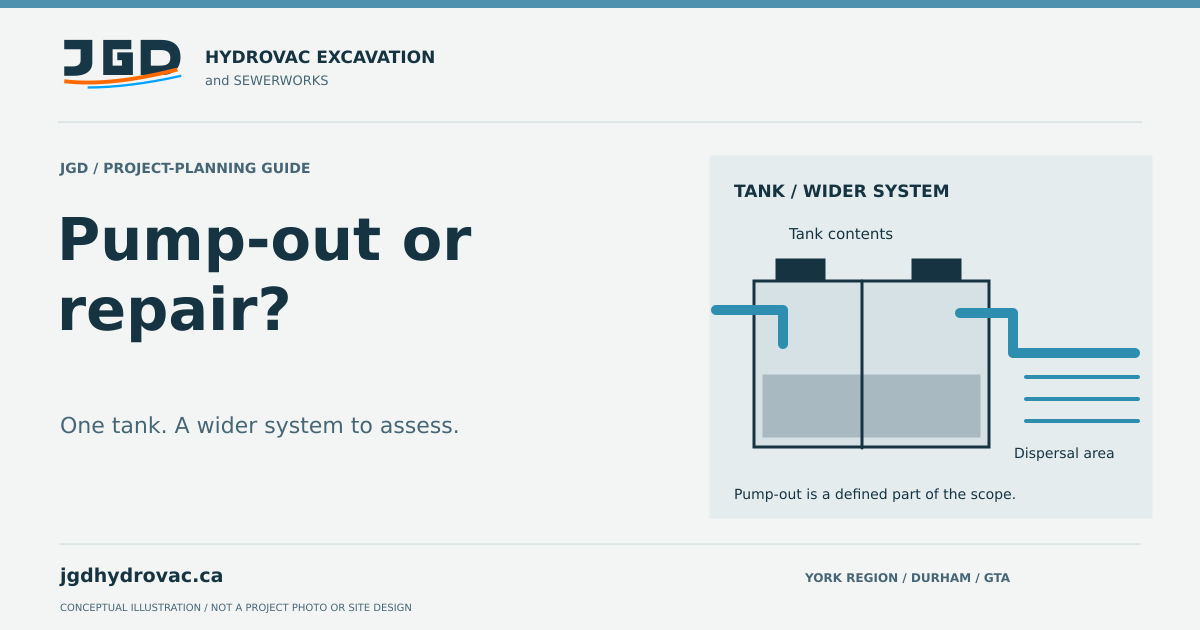
‘The septic needs doing’ can mean a planned tank pump-out, a concern about a backup, or an unresolved system problem. Those requests should not produce the same work order. Start by identifying the purpose of the visit and the records available for the property.
This guide explains the difference between removing accumulated tank contents and investigating or repairing other parts of a septic system. It helps Ontario owners prepare a service enquiry without assuming that a pump-out is a complete system assessment.
The tank is one part of the system
A conventional septic system separates and holds solids in a tank while liquid moves onward to a treatment or dispersal area. The Ontario Onsite Wastewater Association and the U.S. EPA describe these distinct functions. Designs vary, and systems with advanced treatment or mechanical components can have additional service requirements.
That distinction matters when booking: removing contents from the tank is not the same task as repairing a damaged pipe, tank or treatment area. Ask which part of the system the visit covers and what evidence will be needed if the concern extends beyond pumping.
Choose the purpose of the visit
| Your reason for calling | Useful information to provide | Question to settle before booking |
|---|---|---|
| Planned tank pumping | Previous pump-out record, system information and known access details. | What is included in pumping and the service report? |
| A backup or change in performance | When it began, what is affected and any recent system work. | Is an assessment needed as well as pumping, and who provides it? |
| A proposed repair | Existing findings, drawings and the component identified for repair. | Who confirms the repair scope, permissions and qualified personnel? |
| An advanced treatment system | System make/model and any existing maintenance agreement. | Does the visit fit the manufacturer's requirements and existing service arrangement? |
Build a short property information pack
The EPA recommends keeping maintenance and condition records. For an Ontario booking, use those records as a starting point for the conversation rather than treating a U.S. service interval or checklist as a local requirement.
- Gather the most recent pumping invoice and any condition or repair report.
- Provide the tank location and size if documented; label anything uncertain rather than guessing.
- Include available system plans, manufacturer information and maintenance agreements.
- Explain occupancy or usage changes that the service provider should consider.
- Describe truck access, known obstacles and who will be present. Let the provider determine access and working requirements.
If records are missing, say so at the first enquiry. Ask what identification or assessment can be arranged and what remains outside the initial quote. Do not lift lids or enter any tank to find information for this checklist.
Compare the included work, not just the headline price
A useful quote identifies the tank or system being serviced, the pumping task, access assumptions, the service record and how extra work will be approved. Ask whether any inspection, filter service, locating, excavation or repair is included; none should be assumed from the word ‘pumping’.
Also ask what happens if the provider finds a condition that prevents the planned work or suggests a separate repair. Agree on the next conversation before authorizing a larger job. A clear exclusion can be as valuable as an included item when comparing different proposals.
Start a property-specific service conversation through JGD septic services
Use the system's needs to plan follow-up
The Ontario Onsite Wastewater Association explains that accumulated solids need periodic removal and that usage affects pumping needs. Avoid assigning every property the same interval from an online article. Ask the provider to explain the next review or service date using the system information, findings and applicable manufacturer guidance.
If a backup, unusual wet area or other concern persists after pumping, report it and request an appropriate assessment rather than assuming another pump-out is the answer. The person assessing the system should explain which findings support the next step and what remains uncertain.
This is booking guidance, not a diagnosis, sewage-system design or permit determination. Keep people away from open or unsafe structures and contaminated areas. System alterations may need local approvals and appropriately qualified work; confirm those requirements for the actual proposal before authorizing it.
Source notes
These sources support the planning guidance. Provider examples and municipal programs do not establish JGD’s capabilities, terms or your site’s requirements.
- Ontario Onsite Wastewater Association — How a Septic System Works
Ontario industry guidance on septic components, pumping needs and advanced-system maintenance. The service plan must reflect the actual system and use.
- U.S. Environmental Protection Agency — How Septic Systems Work
Explains conventional septic tank and drainfield functions. Used for system terminology, not Ontario legal or design requirements.
- U.S. Environmental Protection Agency — How to Care for Your Septic System
Supports keeping service and condition records. U.S. schedules and thresholds are not presented as Ontario requirements.
- Ontario Onsite Wastewater Association — Septic System Approval Process
Explains finding the local authority responsible for a proposed septic-system application and confirming its process.