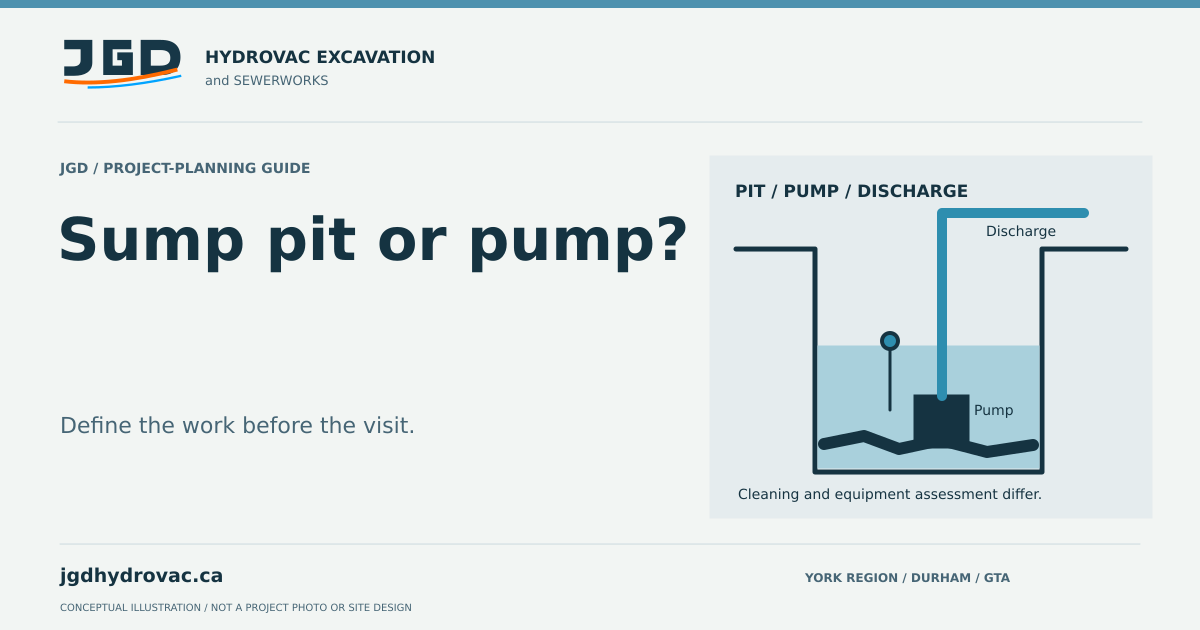
A sump pit and its pump work together, but a request to clean the pit is different from a request to repair the equipment. If the work order simply says ‘sump problem’, the contractor may arrive without the information needed to scope the right visit.
Use this guide to separate what you observed from what still needs assessment. The aim is a clear service conversation, whether you manage a home, a commercial property or a shared building. It is not a diagnosis or a set of instructions for opening, entering or working on a pit.
Three parts to describe: pit, pump and discharge
In a foundation-drainage system, a sump pit collects incoming water and a pump moves that water through a discharge line. The Town of Aurora describes this arrangement and notes that pumps require maintenance and depend on electricity. That explanation does not tell you which part is responsible for a particular problem.
| Part of the system | What to ask the contractor | What that request does not establish |
|---|---|---|
| Collection pit | Does the visit include assessment and removal of accessible accumulated material? | Whether the pump or discharge is functioning correctly. |
| Pump and controls | Who will assess operation, controls and any repair or replacement needs? | That emptying or cleaning the pit fixes an equipment fault. |
| Discharge route | Will the outlet route be checked, and is that part of this quote? | That moving water out of the pit provides suitable drainage for the property. |
Record observations without guessing at the cause
A useful note distinguishes ‘water was above the usual level at 7 a.m.’ from ‘the pump is broken’. The first reports something you saw. The second assumes a cause. Keep your description factual so the person assessing the system can decide what needs checking.
- Note when the concern started and whether it followed rain, snowmelt, an outage or another change.
- Describe what you can observe safely: unusual water level, an alarm, a sound or a recurring pattern. Do not reach into the pit to investigate.
- Find previous invoices, system drawings or equipment details you already have. Do not remove covers or handle electrical equipment to obtain them.
- Tell the contractor whether the pit is in a house, mechanical room, parking area or another setting. A commercial collection pit may require a different scope from a residential foundation sump.
A work-order checklist for owners and property teams
Before booking, ask for the scope in writing. Separate the cleaning task, equipment assessment and any follow-up repairs. This gives you a better comparison than two quotes that both use the word ‘sump’ but include different work.
- Identify the specific pit and the property contact who can provide access.
- Describe access restrictions, building rules and the available work window; let the contractor determine the safe working method.
- Ask what cleaning includes, how recovered material will be handled, and what information will be left in the service record.
- Ask whether pump testing, electrical work, discharge assessment and parts are included, excluded or referred to an appropriate trade.
- Agree how unexpected conditions or extra work will be approved before the scope expands.
For a portfolio of properties, keep the pit identifier on the invoice. A note attached to the right asset is more useful at the next visit than an invoice filed only under the building name.
When a maintenance request becomes urgent
An actively flooding area needs a safety response before routine cleaning is arranged. Public Safety Canada warns that floodwater and electrical equipment can be dangerous. Stay out of flooded areas where electrical safety is uncertain, and follow the directions of emergency officials and the appropriate utility or qualified professional.
Do not enter a pit, bypass controls, handle a wet plug or attempt electrical repairs based on this guide. Report the conditions from a safe place. A request for emergency help should say what is happening now and whether anyone can safely access the area; it should not promise that a particular cleaning task will resolve it.
For pit-cleaning enquiries and access planning, see sump pit cleaning and pumping
Keep a record that helps the next decision
Ask the service record to identify the pit, the task completed, visible findings, any assessment that was outside scope and the recommended next step. If water levels or alarms recur, that record helps the next contractor understand what has already been done.
Set any follow-up maintenance plan around the actual system, observed conditions, manufacturer guidance and the advice of the person assessing it. A calendar reminder is useful; an unsupported promise that every sump needs the same cleaning interval is not.
Source notes
These sources support the planning guidance. Provider examples and municipal programs do not establish JGD’s capabilities, terms or your site’s requirements.
- Town of Aurora — Basement Flooding
Explains several basement-water routes and the collection, pumping and electricity considerations of a foundation sump. Local municipal procedures apply to Aurora.
- Public Safety Canada — Floods — Get prepared
Federal flood-safety guidance on floodwater, electrical hazards and following qualified assistance and official directions.